
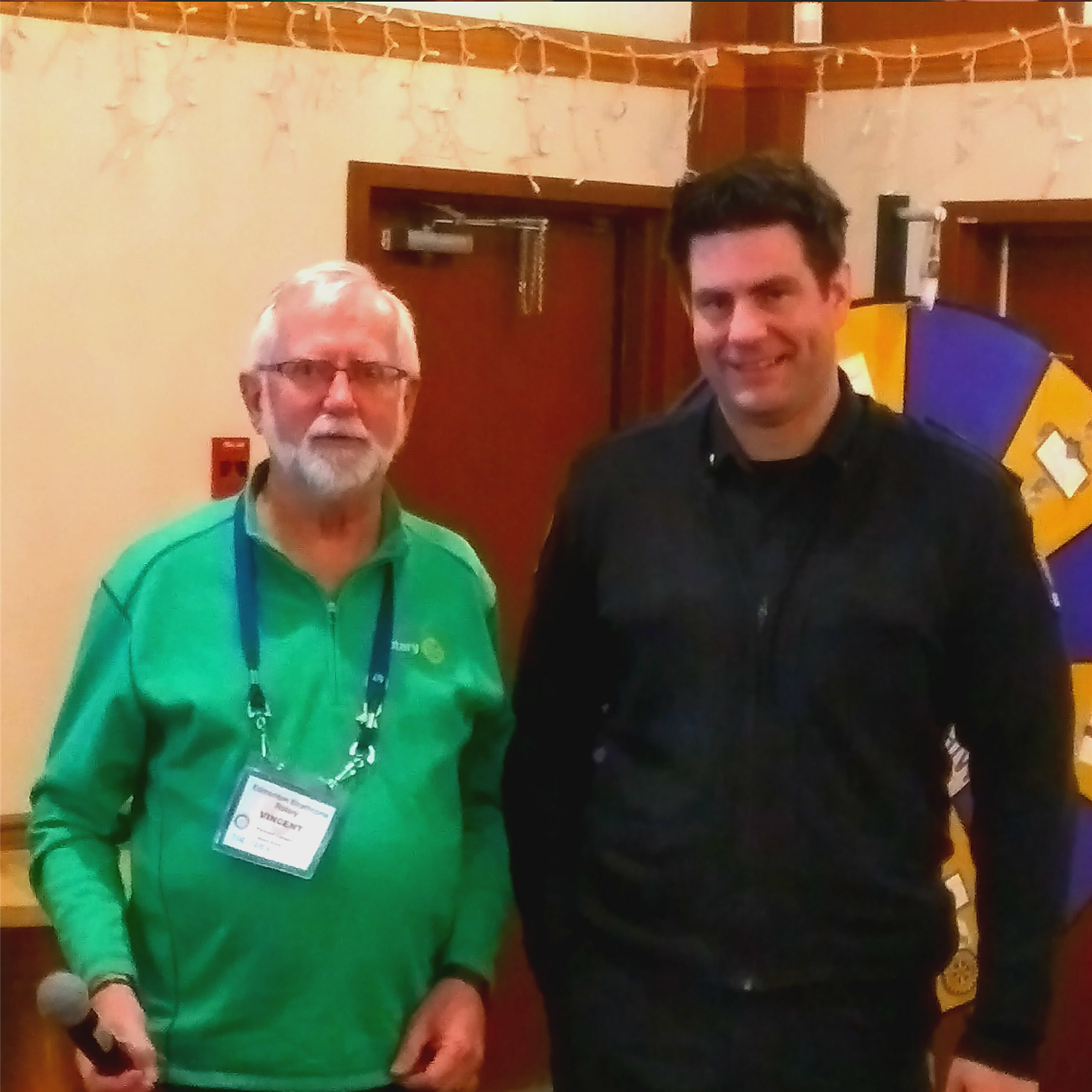
This past Tuesday we heard from Alex Campbell, pictured, a Paramedic and Public Education Officer with Alberta Health Services. He spoke to us about the provision of Emergency Medical Services (EMS) in Alberta and also gave us some basic information about Fentanyl and its impact in our community.
The EMS in our province serves four million Albertans, and their dispatch services handled over half a million calls last year. They also provide a transfer service using fixed wing aircraft for patients from more remote areas and provided critical care and transport for fifty-five hundred patients in this way last year. In addition, the STARS helicopter, which is funded separately by donations, flew another two thousand missions. They have four thousand EMS practitioners and five hundred fifty ambulances in Alberta. Alberta Health Services uses contract providers to deliver services and there are currently about thirty different contractors. These often include local fire services as they are also trained to handle some types of medical emergencies and are often closer to the emergency. In many cases both the EMS and Fire services will co-respond as the firefighters provide a valuable complementary service to the paramedics.
Alberta also has the first stroke ambulance in Canada. It has a CT Scanner on board and all the equipment needed for immediate treatment of a stroke victim. It is run from Edmonton, and will often meet incoming ambulances with stroke victims, pull off to the side of the road, transfer the victim to the stroke ambulance, scan and treat them immediately, then transport them to the hospital. This gives the patient quicker access to treatment and results in much better outcomes, as every minute counts with stroke victims.
Alex also gave us an introduction to the Fentanyl problem in our community. Fentanyl is an approved medicine that has been in use for some time now and is a very effective pain killer. It has a fast onset and wears off quickly so it is often used by paramedics for patients with broken bones. It is also used when patients need to be intubated to help them breathe, as it effectively suppresses their natural attempts to breathe.
Fentanyl became a drug of abuse by a round about route. It started with the development of a very effective (and also addictive) long lasting oral pain medication called Oxycontin, which came to be widely prescribed. Unfortunately, it also became widely consumed illegally by crushing and snorting it, or by dissolving the tablets so that it could be injected. In 2012 the formulation was changed so that the tablets could not be crushed or dissolved and addicts began looking for alternatives. As fentanyl is relatively easy and cheap to produce, gives a similar high and is also highly addictive, it became a drug of choice for illegal dealers. It can be easily purchased on the internet from many different illicit production facilities in China and is easily shipped into Canada by mail. The fact that it is extremely potent, with only one milligram needed, and has a very narrow range of safety, two milligrams will kill fifty percent of people, does not discourage addicts.
The fact that it is so potent makes it very lucrative by weight, with one kilogram being worth twenty million dollars on the street, as compared to marijuana at ten thousand dollars per kilogram, or heroin at one hundred thousand dollars per kilogram. A small letter weighing less than thirty milligrams, which cannot legally be opened by Canada Border Services without the addressee’s permission, can contain six hundred thousand dollars worth of fentanyl. The fact that such a small amount is needed per dose also means that in a powdered form it cannot be ground fine enough or mixed well enough with filler to make oral pills with a safe consistent dose. Unfortunately, this is how the drug is prepared by dealers, who grind and mix illegally sourced fentanyl with caffeine powder or other filler using an ordinary bullet blender and then press it into pills using a small illegal pill press. The result is pills that contain any where from no fentanyl to six milligrams or more. These pills can also not safely be split to lower the dose as the fentanyl particles are not all the same size or distributed evenly enough. In addition, it is also commonly now added to marijuana, fake oxycontin pills, methamphetamine, cocaine and other drugs of abuse to increase their addictiveness.
In 2016 we saw three hundred and sixty six deaths from fentanyl in Alberta and in 2017 we saw five hundred and sixty two. Deaths are occurring at all ages and at levels of society, this is not just an inner city problem. The current line of defense for fentanyl is Naloxone, which effectively blocks the effect of fentanyl, but is not a perfect answer to the problem. Naloxone needs to be available to be injected quickly once a person stops breathing, and someone who is not also using needs to be available in order to do this. Also, because it is often mixed with other drugs, which it does not treat, it may not be fully effective. The relaxed access to Naloxone kits and the opening of safe consumption sites for addicts will help to stem the tide, but it is definitely not the perfect solution. We all need to work together to find better ways to deal with this problem.
In closing, we would like to thank Alex for his expertly presented, interesting and informative talk.