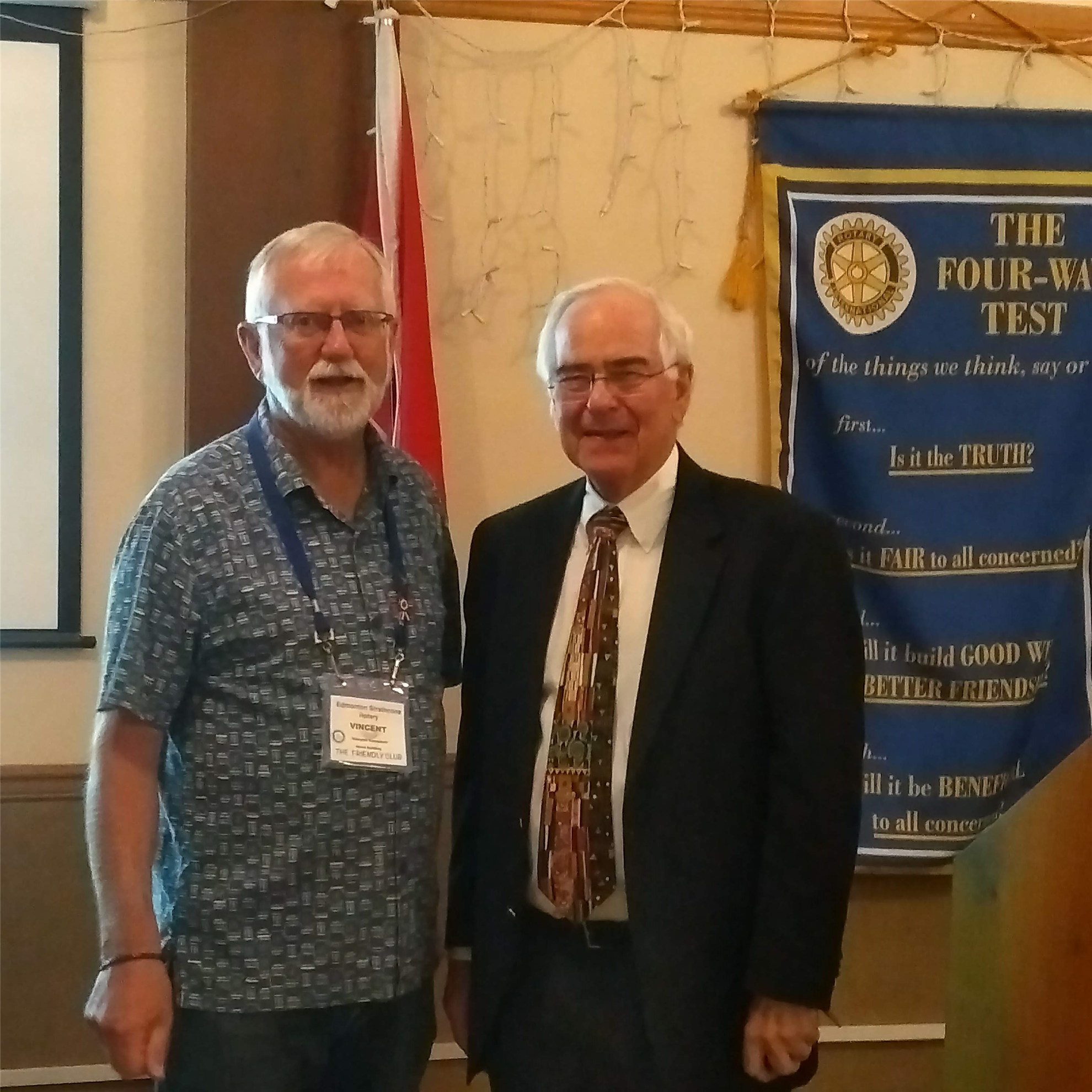
This last Tuesday we heard from Kevin Keough, the Executive Director of the Alberta Prion Research Institute. The Institute was created by the Alberta government in 2005, in response to the mad cow disease incident that took place in Alberta in 2003. It is funded by the government of Alberta and is a part of Alberta Innovates. To date, it has received over seventy-five million dollars in funding. It’s function is to promote and support research that focuses on innovative approaches to prions and prion like diseases.
Prions have and will continue to have an impact on our lives. They cause unusual diseases in animals and are also suspected of being involved in some human diseases as well. Prions are unusual infectious agents, as they have no genetic material, being composed of a single protein, that can vary from disease to disease. The protein is one which in it’s normal state has a useful function in the body, but once it becomes deformed, it can then cause more of the same proteins to also become deformed, building up in the body like a chain reaction. Because of this, it can not be ’killed’, which creates all kinds of challenges. The main animal diseases caused by prions are Bovine Spongiform Encephalopathy (BSE) which affects cattle, Chronic Wasting Disease (CWD) which affects deer, elk, moose, caribou and reindeer, Scrapie which affects sheep, and Creutzfeld-Jacob Disease (CJD) which can be spread from cattle to humans when they eat infected beef. CWD, in particular, is expected to have an increasing impact on our local wild populations of grazing animals as the prions are found throughout the infected animal, and are deposited on the ground in feces and urine, where they contaminate the soil and vegetation. They can then be eaten by other grazing animals and cause them to become sick.
This disease was first found in Alberta about twelve years ago, near the border with central Saskatchewan and is slowly spreading north and west through the river valleys in populations of wild white tail and mule deer. There is no known treatment, and the infected animals can not even be diagnosed until after they are dead. Other prion like diseases in humans are some forms of Alzheimer’s disease, Frontal-Temporal Dementia (FTD), Parkinson’s disease. Tauopathies, Amyotrophic Lateral Sclerosis (ALS) and other dementias. Each of these diseases have a characteristic build up of a specific deformed protein that is a hallmark of the disease, although they do not have the ability to infect other people, in the way that the animal prion diseases do.
Current research supported by the Institute includes things like developing new animal models to study these diseases, searching for new diagnostic methods and biomarkers, looking for therapeutic approaches and investigating the fundamentals of what is going wrong. The Institute currently supports the largest group of prion researchers in the world, through offering grants and fellowships to qualified Alberta based researchers with innovative approaches. They are very proud to be supporting world class research into prion diseases, right here in Alberta.