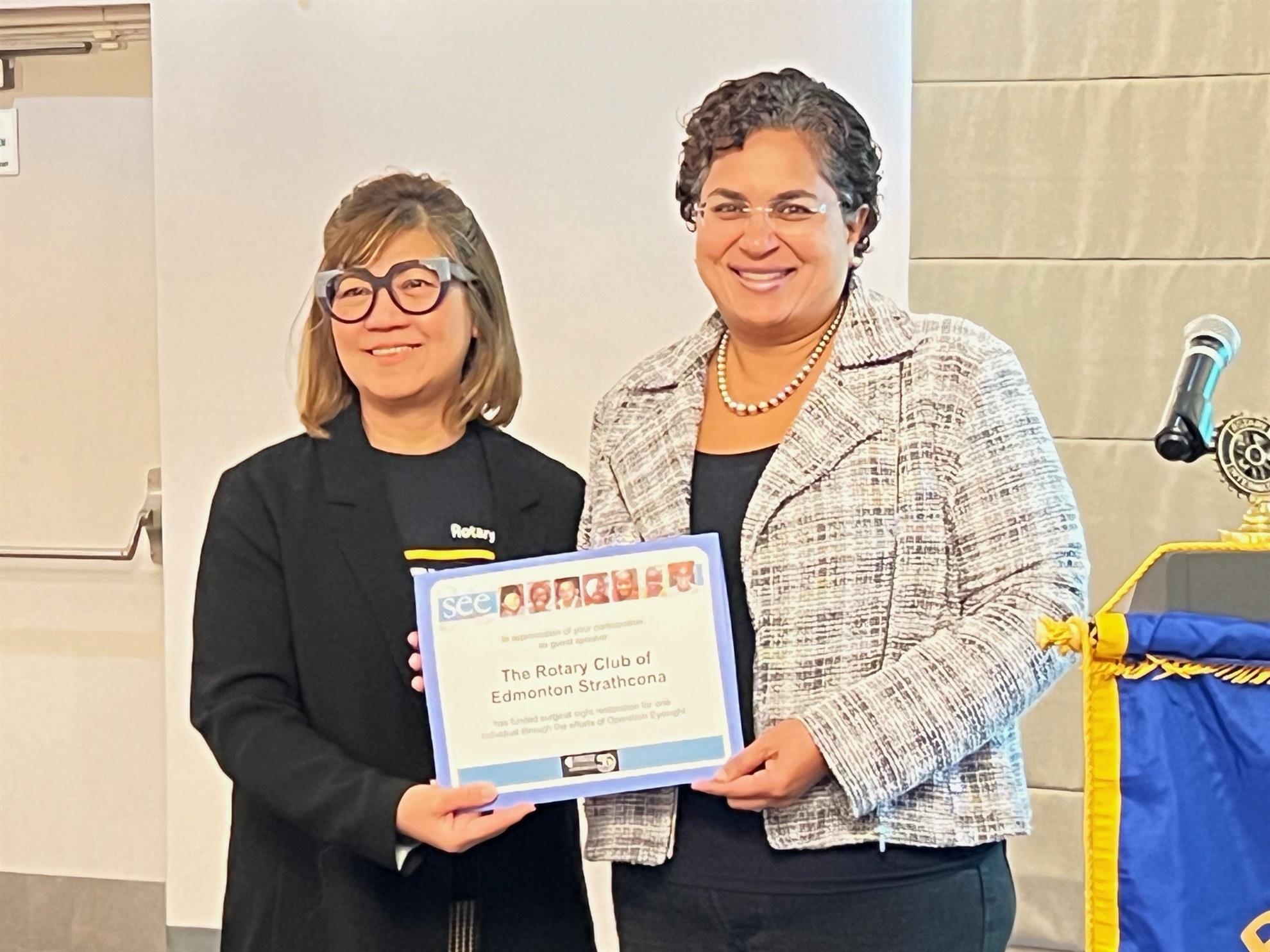
Pres. Elect Loida Lumanlan with Dr. Sunita Vohra
This week we heard from Dr. Sunita Vohra, Centennial Professor in the Depts. of Pediatrics and Psychiatry in the Faculty of Medicine and Dentistry at the U. of A. Sunita told us that she researches child based initiaives in healthcare with a particular interest in youth mental health. She said that youth mental health is in crisis now, with Alberta Health data showing that more and more youth are visiting our hospitals for mental health issues. She also said that depression, anxiety and behavioral disorders are among the leading causes of illness and disability in our young people.
Sunita has been researching, building and evaluating evidence for a method known as mindfulness for many years. It has been shown that after eight weeks of mindfulness training, young people find it much easier to walk away from violence, have better self esteem, are more likely to stay in school and are more likely to follow medical advice. They gain the ability to regulate their emotions and a sense of resiliency that allows them to better cope with what ever life presents them with. She said that mindfulness based meditation helps one to be present in the moment, to be able to pay attention in a particular way and it helps people to gain a non judgemental more open minded approach to life. She also said that the younger people are when they start this program the better it works. She also said that there is evidence that this type of training also creates physical changes in the body by turning genes on and off to reduce inflammation, which in turn improves physical health in many ways as well. It has also been shown to result in changes in the brain structure and how networks of nerves in the brain work.
Sunita said that she and her team are currently working with CASA (Child and Adolescent Services for All) in their residential treatment program to present a mixed methods study and evaluate it using quantitative, qualitative and neuroimaging methods. Qualitative results to date have shown improved mood, enhanced relationship to self, increased self control, improved problem solving, awareness of the present and enhanced interpersonal relationships.
Sunita said that she and her team have also conducted a systematic review of a method known as Mindfulness Based Stress Reduction (MBSR). They compiled results from twenty nine studies and have shown that MBSR is moderately effective in reducing stress, depression, anxiety and distress and in improving the quality of life of healthy individuals.
Sunita said that there are many different types of mind body therapy programs ( MBSR, Tai Chi, Yoga, Qi Gong, Mindfulness, Guided Imagery, Meditation etc.) available, that have been independently validated, each with it’s own strengths. She said that they have been asked to provide recommendations to the school boards on which programs are best for them and have prepared and presented a guide to help the schools decide on which type of program is best for them.
She told us that she and her team are currently working on preparation of a Clinical Practice Guideline for child and youth mental health providers to provide evidence based recommendations for use by policy makers, decision makers, medical, educational and other professionals to use. This guideline will be based on an evaluation of the more than two hundred currently available randomized controlled trials. It will also build on the tool kit that their team prepared for our local school boards. They have received funding to cover some of the cost of this work but are hoping that Rotary, with it’s interest in youth and mental health, would also be able to help.
We would like to thank Dr. Vohra for her very informative and interesting talk.