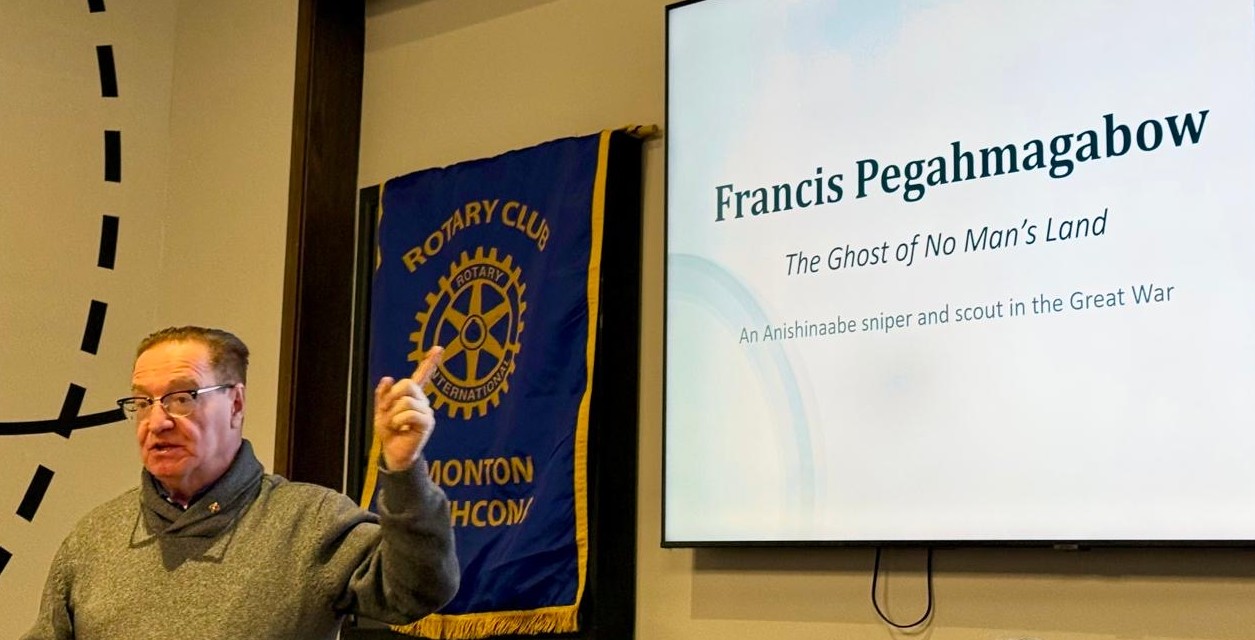
This week we were very pleased to welcome our Past Club President and well known Canadian military historian, Norman Leach, to mark Remembrance Day by telling us the unforgettable story of one soldier during the First World War.
Norman began by telling us that when World War I began in August of 1914, Canada committed to Britain to send thirty thousand men by April of 1915. In 1914 the Canadian Army only had just over three thousand men, so that meant they would have to recruit and train a very large number of men in a very short time. Francis Pegahmagabow was one of these men.
Francis was an indigenous man born in 1891 on the Anishanabe reserve on Parry Island, Ontario. He was orphaned very young and was subsequently raised by elder Noah Nebimanyquod. Noah taught Francis many skills that made him a very good hunter. How to be patient and alone and how to play a game that involved creeping up close, quietly and unseen, in a touch game that echoes the adult version of ‘counting coup’. Among Plains Indians, in battle, counting coup was a very prestigious act of intimidation that involved sneaking up and touching an enemy warrior with a hand or stick and escaping unharmed and without harming the enemy, except for their pride. Francis had a natural talent for all of these things.
When war was declared, Francis signed up within days. Signing up for an indigenous person was a very big thing, as it would mean that they would lose their rights under the Indian Act, but they would also gain the rights of any other Canadian citizen (for example, the right to vote). This meant they would lose financial support (however they still retained their right to live on a reserve without receiving benefits). These things were carefully explalned to all indigenous men who wished to sign up. It was a very big decision to make and some declined to do so.
Francis was assigned to the 1st Canadian Infantry Batallion and was deployed to France in February of 1915. Francis proved to be a very good marksman and was also a very fast runner. At that time wars were still fought using animals to haul heavy equipment and carry messages from one location to another. Their enemies were shells, snipers, gas, wire, disease and lots of mud. The enemy soon learned to shoot any animal or bird that crossed their line as it may be carrying messages. The British then turned to using human messengers and soon found that Francis had the skills to become a very good dispatch runner, carrying messages across the no man’s land between British and German lines, one of the most dangerous jobs.
In July of 1916, the Battle of the Somme saw more than one million killed, wounded or missing. Francis was shot in the leg. After he recovered, in 1917, he went back as an almost full time sniper and scout. He sent home for his moccasins to wear, as they were much quieter. He could patiently wait hours and sometimes up to three days, sitting in mud, in order to make a shot. He personally considered shooting from a distance dishonourable and would some times simply sneak up and touch the enemy in their trenches while they were sleeping then escape unharmed. He became a much feared ghost among the enemy. At the Battle of Paschendale in 1917, the mud swallowed many men and our barrage fell short. Francis crept up unauthorized and fired a white flare which caused the enemy barrage to stop. He subsequently received a Bar to the Military Medal for this act of bravery. According to some of his family accounts, in 1918 at the battle of Amiens and Scarpe, he and his fellow soldiers ran low on ammunition near Amiens and could not replenish it easily, so Francis crept out and stole ammunition off the bodies of dead men and brought it back to use.
By the end of the war, Francis had three hundred and seventy eight confirmed kills and more than three hundred soldiers captured. He was also only one of thirty nine men in the Canadian Expeditionary Force, a very rare honor, who had earned the Military Medal and then two bars to the Military Medal.
After the war, Francis suffered from what we now know as PTSD, which the doctors dismissed at the time. In spite of this, he became an activist and leader in the indigenous community, the Chief of the Wasauksing First Nation, a tribal councillor and the Supreme Chief of the Native Independent Government, an early First Nations organisation.
Norman told us this past summer he was a history consultant on the production of an eight-part docuseries titled ‘300 Days of War’ that celebrates Indigenous men and women in the Canadian military over WWI, WWII and the Korean War. Francis was one of these people. This docuseries will be aired next year.
He ended his talk with the Historian’s Creed:
History is not there for you to like or dislike, it is there for you to learn from it. And if it offends you, even the better. Because then you are less likely to repeat it. It’s not yours to erase. It belongs to all of us.
We would like to thank Norman for his very moving story of this courageous man and hope that none of us will forget the heroic acts and sacrifices many others have made for us in the past.